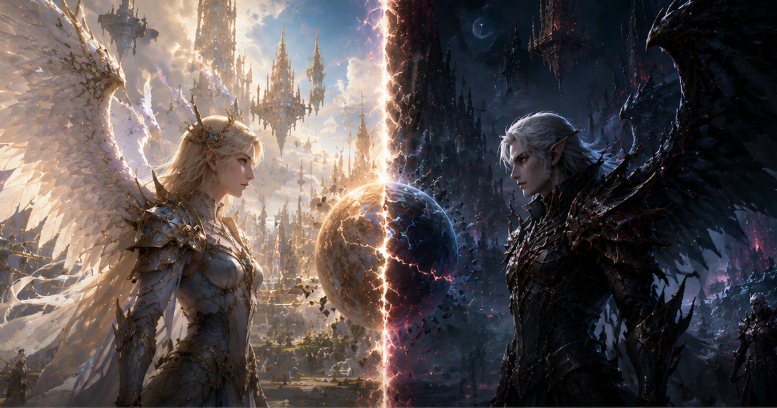
Aion 2 initially appears to follow this structure with its striking visual contrast between Elyos and Asmodians. However, beneath the aesthetic divide lies a far more complex narrative—one built on survival, consequence, and irreversible tragedy.
The Cataclysm That Broke the World
The foundation of Atreia’s conflict begins with a catastrophic event known as the Cataclysm, which shattered the planet into two opposing halves.
Elyos – The Light-Bathed Survivors
The Elyos were cast into the upper world, where they remained exposed to sunlight and fertile land. Their environment preserved beauty, stability, and life. Over time, their appearance evolved into radiant, winged beings often associated with purity and divinity.
Asmodians – The Survivors of Darkness
The Asmodians fell into the lower abyss, a frozen, hostile environment with no sunlight. Survival demanded adaptation. Their bodies evolved into hardened, shadow-bound forms with physical traits suited for extreme survival conditions.
This divergence was not ideological—it was environmental necessity.
A Zero-Sum Reality of Survival
The most important truth in Aion 2’s world is that peace is structurally impossible. The world itself is collapsing. Aether, the planet’s core energy, is slowly destabilizing, and both factions depend on limited remaining resources to survive.
In this system, every gain is a loss for the other side.
When Elyos forces secure territory, they preserve stability for their population.
When Asmodians invade through rifts, they are securing survival access routes.
When battles occur, they are not symbolic—they are existential.
Even economic systems such as Aion 2 Items and Aion 2 items for sale exist within this fractured ecosystem, reflecting how survival, trade, and conflict are deeply intertwined across both factions.
Conflict Without Villainy
What makes Aion 2’s narrative unique is the absence of moral certainty. Neither faction acts from pure aggression or ideological conquest. Instead, every action is shaped by scarcity, pressure, and environmental collapse.
An Elyos soldier defending territory is not pursuing domination—they are protecting the structural conditions that allow their civilization to survive. Likewise, an Asmodian raid into enemy land is not an act of cruelty—it is an attempt to secure resources before extinction becomes inevitable.
The result is a continuous cycle where both sides are simultaneously defenders and invaders.
Aion 2 ultimately places the player in a morally ambiguous role. Choosing a faction is not choosing “good” or “evil,” but choosing perspective. Your actions define how you interpret survival, sacrifice, and necessity within a collapsing world.
Aion 2 rejects simple moral storytelling in favor of a more uncomfortable truth: there are no heroes in Atreia, only survivors. Every battle is a consequence of a broken world, and every player becomes part of a system where morality is replaced by necessity.
