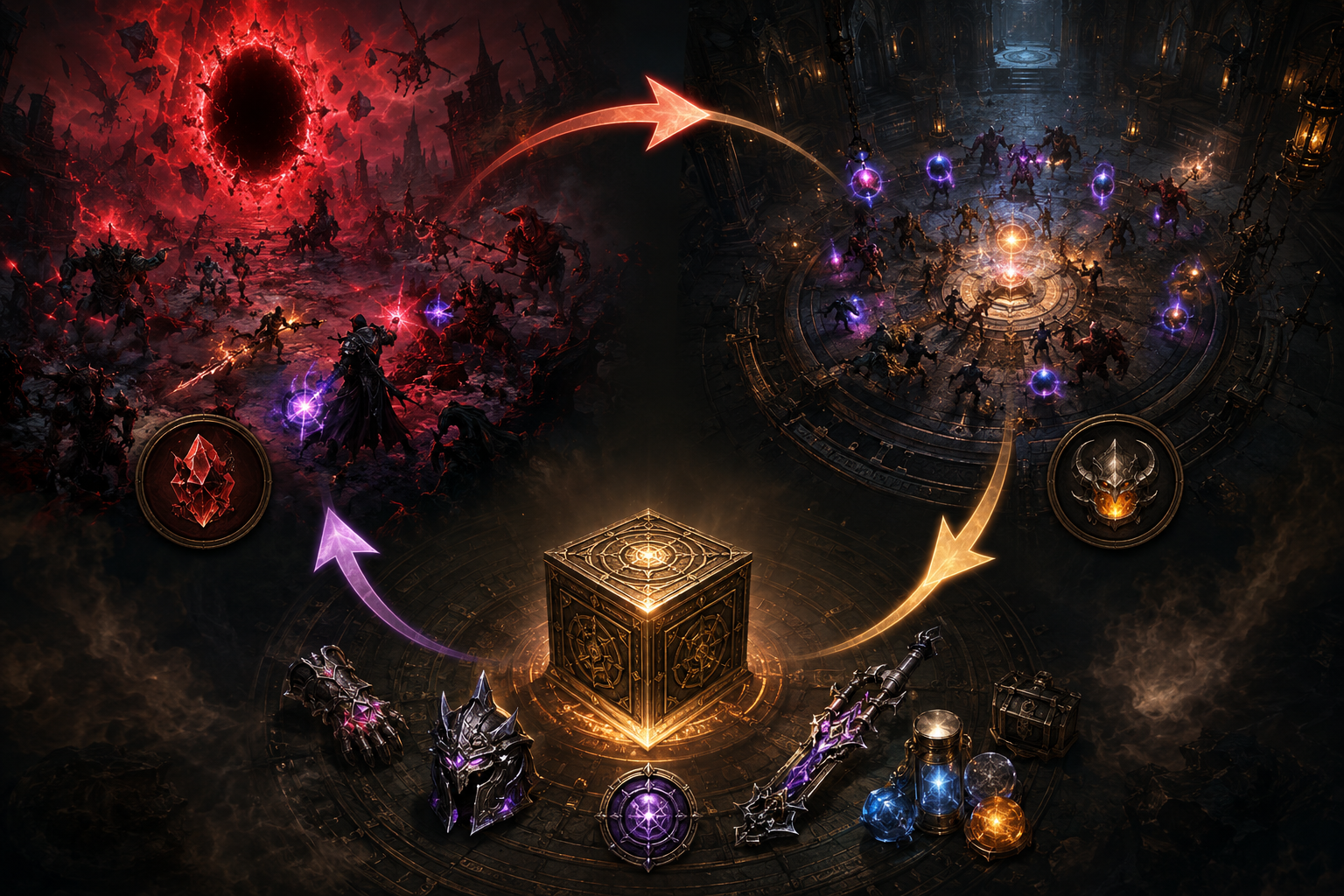
Season 14 PTR 3.1 introduces a tightly connected endgame loop built around Pandemonium Ruptures, the Deathtoll Chamber, and the Horadric Cube. Instead of isolated farming activities, progression is driven by a continuous resource conversion cycle where combat time is transformed into upgrade power.
The core system functions as a three-stage loop:
Pandemonium Ruptures → Deathtoll Chamber → Horadric Cube
Each stage has a distinct role. Ruptures generate entry events and Pandemonium Fragments. The Deathtoll Chamber converts combat into high-density materials such as Betrayer’s Husks. The Horadric Cube transforms these materials into direct character progression through crafting, upgrading, and optimization. This is not a traditional loot loop but an economy-based conversion system.
Pandemonium Ruptures are the starting point. These are open-world scaling events designed for sustained combat rather than quick clears. The primary objective is to farm Pandemonium Fragments while maintaining continuous enemy engagement. Players should remain inside active rupture zones for as long as possible, prioritizing dense enemy packs over isolated elites. Efficiency comes from uptime, not speed. The longer you sustain combat density, the higher your overall fragment yield and event progression.
Once sufficient progression is reached, players transition into the Deathtoll Chamber through Realmwalker triggers. This phase compresses raw combat performance into crafting value. The Chamber introduces wave-based encounters where Orb mechanics influence difficulty scaling and reward output. Proper control of Orb flow is essential, as mismanagement can spike difficulty while reducing efficiency. The optimal approach is maintaining stable enemy density, using AoE-heavy builds to control the entire arena. The goal is consistent material generation, especially Betrayer’s Husks, rather than rapid wave clearing.
The final stage is the Horadric Cube, which serves as the primary conversion engine for progression. Here, collected materials are transformed into meaningful power gains. The Cube allows three major functions: Diablo 4 Mythic item creation and upgrades using Pandemonium Fragments and rare materials, gear re-optimization through affix re-rolling and breakpoint tuning, and resource recycling to maintain long-term efficiency. This system ensures that all farming output directly feeds back into character progression instead of sitting as unused loot.
The optimal loop structure is straightforward. Players enter Pandemonium Ruptures to farm fragments and trigger high-density events, then transition into the Deathtoll Chamber via Realmwalker access, where they farm Betrayer’s Husks and compressed materials. After clearing, they return to town to process everything through the Horadric Cube before re-entering Ruptures with upgraded power. This cycle repeats continuously.
Advanced optimization focuses on timing and scaling efficiency. Experienced players stack multiple Rupture zones before entering the Chamber, delay Cube usage until multiple upgrade thresholds are reached, and only re-enter Ruptures when gear upgrades significantly increase clear speed. This creates a compounding snowball effect in farming efficiency over time.
To fully support this system, builds must prioritize three core attributes. First, high AoE density output for both Ruptures and Chamber encounters. Second, sustained combat uptime with minimal downtime, cooldown dependency, or repositioning. Third, strong defensive stability, since Chamber content is enclosed and punishing. Barrier systems, sustain mechanics, and crowd control resistance are essential to prevent run failure, as death directly breaks loop efficiency.
Mastery is not about farming more content, but about reducing wasted time, maximizing conversion efficiency, and continuously upgrading gear to accelerate every subsequent cycle.